Denny Bershaw
My First Penton Ride and the 1968 Six Days
story and photos by Denny Bershaw
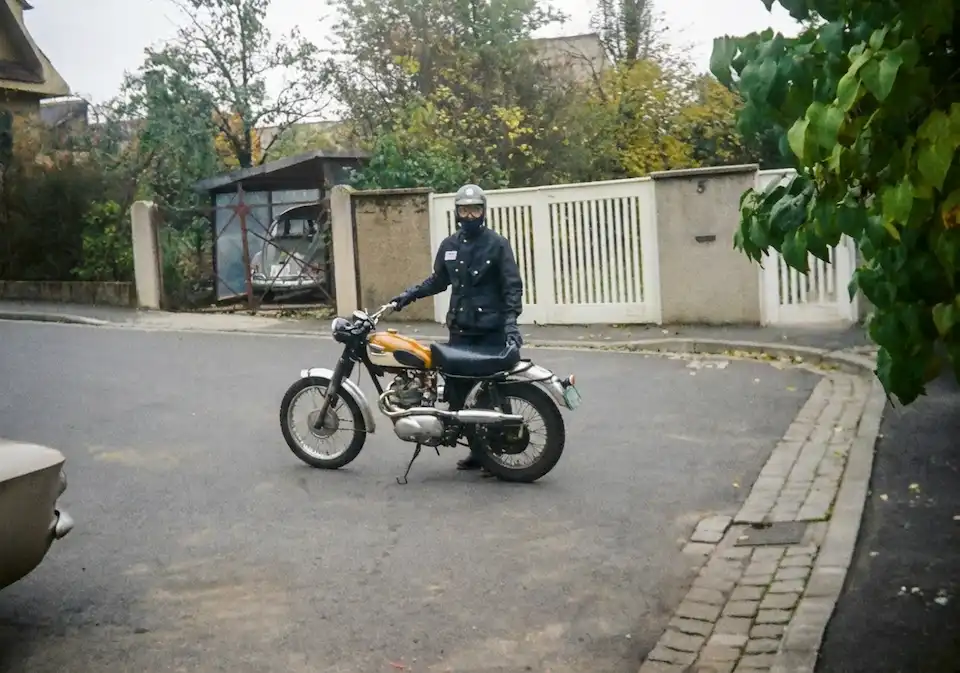
My wife Chris and I arrived in Germany on our daughter Karan’s first birthday, 13 October 1965. My clinic chief, Lieutenant Colonel Charles Ross, and his wife picked us up in Frankfurt and wasted no time informing me that there could be no motorcycle riding for me in Germany. I kept my mouth shut about the Triumph T-100C that was waiting in Bremerhaven, and wished I’d not brought up the subject.
Colonel Pierre Evans, the Commander of the 124th Medical Detachment in Wurzburg, said pretty much the same thing, with more of a frowny face. This time I was smart enough not to object.
Chris didn’t want to live on Post – her father was a Major General, and she’d had enough Army, thank you very much – so we lived in Gochsheim, a small town outside of Schweinfurt. I rode the Triumph to work most days and went into the woods on weekends. The Germans were excited about the Triumph, a rare four-stroke in a town dominated by small two-strokes with Sachs engines. The gas stations pumped two-stroke mix along with regular gasoline, and I always had to turn down the two-stroke brew they wanted to pump into the Triumph. Most of them had never seen an English Triumph. The police in Schweinfurt used German Triumphs, a very different machine.
Then, six months later, in April of 1966, Chris spotted a rental ad for a house in Schweinfurt in the local paper. The ad was in English, clearly aimed at an American renter, so I met the owner, Claus Waker, at the house. He walked around the Triumph, shaking his head. “You need to have one of ours,” then went on to tell me he was in charge of Research and Testing at Fichtel & Sachs. The factory was a block away from the house.
So we rented the place, and I continued to ride the Triumph around the countryside.
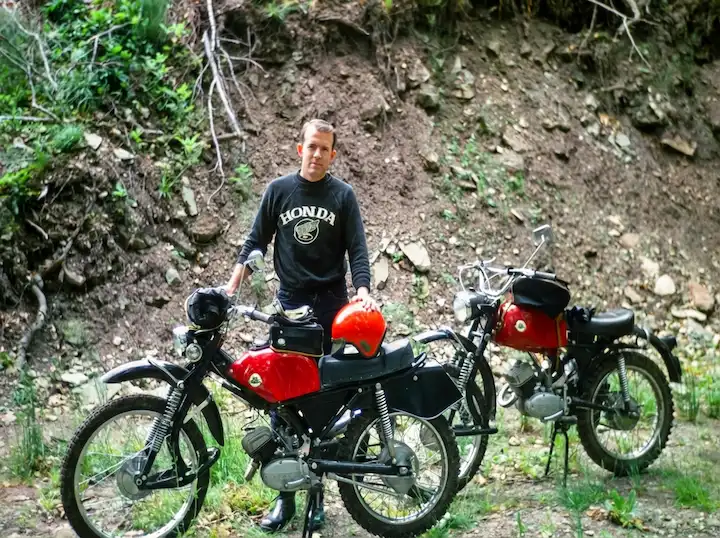
Six months later, for $100 and a carton of unfiltered Camels, I had a 50cc GS Hercules. One of the factory mechanics came over to the house every day and went through the little bike. In the end it was essentially a new machine. To my amazement, the thing was a lot more fun in the woods than the Triumph. No great amount of power, but it handled well and the narrow front tire – 2.50 X 21” – cut through the slime and muck with no difficulty.
The next year, in 1967, Herr Waker provided me with a 1966 Factory bike, which was even more fun, particularly when the 73 cc. cylinder and piston were installed. The torque improvement was incredible.
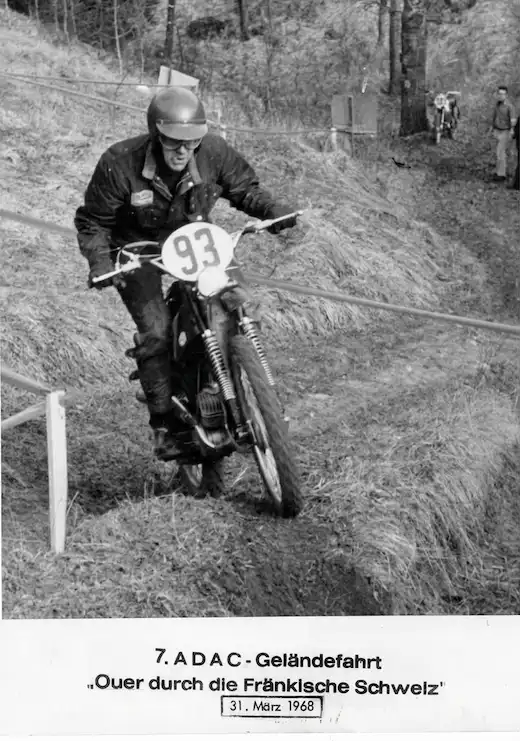
I read everything I could from the States and England, so I had some idea of the growth of off-road motorcycling back in the land of big PX. The Germans were convinced I had my finger on the pulse of dirt riding in America, and I didn’t tell them any different. Herr Waker took me to meet Fritz Witzel, Sr., and Fritz was kind enough to arrange the German version of off-road play dates. Sometimes these would be with Fritz, who was a Maico factory rider, but mostly they were with Rudi Tellert, a local young hot-shot. Rudi was fast and cocky on a 175 cc. Hercules, but I was in good condition and could mostly keep up with him.
Fichtel & Sachs had purchased Hercules in Nurnberg in the mid-Sixties, with the marques DKW, Express, and Victoria folded into that acquisition. Sachs was very interested in the burgeoning American off-road market.
They were not alone. In October of 1966, KTM placed a twopage ad in Cycle World, touting both their road and dirt machinery.
At some point in late 1967 or early 1968, Fichtel & Sachs became aware of the ongoing talks between John Penton and KTM. At the same time, Hercules was cutting a distributor deal with Ted Lapadakis in California, so sales of the new 100-125cc. engines were clearly going to increase on two fronts, both in America.
In March of 1968, I decided to try my hand at competition. German rules required that all competitors belong to a motorcycle club, so I joined the local ADAC club, got my license and entered a few events. Until you have been passed in the woods by a BMW, you cannot know true embarrassment, but second time out I won my class and gold (the 75 cc. class was not burdened with a large numbers of entries).
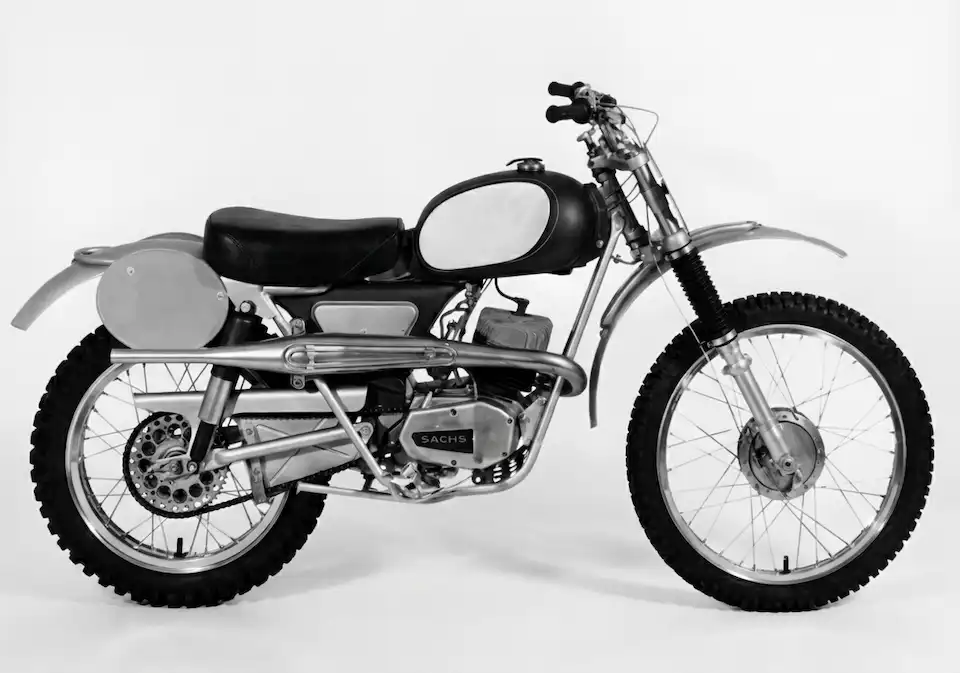
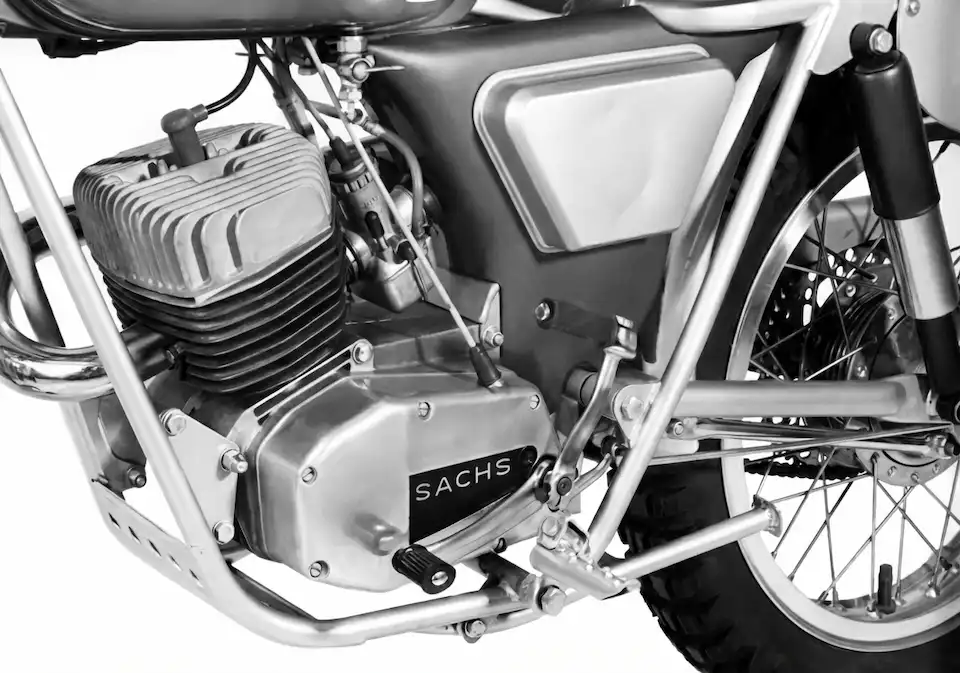
In July, Ted Lapadakis, accomplished desert racer, shrewd businessman, and member of the Checkers MC, arrived in Germany and I got to take him around, including a day at the local club’s annual off-road event. Mud, ruts, and trees were not his favored environment, but he wanted me at the Six Days in Italy to translate for his fellow club members, all on Hercules. Since he was picking up the tab, I said ‘yes’ and applied for Leave in October.
Then in August, Herr Waker phoned and asked if I could come over to the Factory on the next Wednesday afternoon, in my riding gear. Easy enough, I figured. He didn’t give me any more information, just that it would be a surprise.
It was.
The gate people waved me in, apparently used to people in riding boots and a Barbour jacket trooping in and out of the Sachs factory. I found Herr Waker and a handful of blue-coated engineers surrounding the first Penton I’d seen. With them was Max Kaiser, the engine guru for Hercules/Sachs in Europe. His nickname was ‘Kaiser Sachs,’ and he was a wizard.
The engineers were not happy with the frame welds and a few other details, but Herr Kaiser over-ruled them, saying the components were first-rate, the geometry was excellent, and he thought the machine would work well.
Herr Waker introduced me to the group, I shook hands all around, then went for a ride. The gate guard waved as I wheeled out onto Ernst-Sachs Strasse and headed north through town toward the woods. The bike was loud, but I didn’t care.
After the 75 cc. Hercules, the Penton produced some real power, plus it was wonderfully responsive and very nimble. Traction on the trails was perfect, and two to three hours was barely enough, considering the level of fun. I stopped at a seasonal Gasthaus in the woods, and everybody had to go out and look at the bike, including all the hikers. Small mopeds and motorcycles were the primary medium of travel in Germany after World War II, so the Penton was a big hit. We rode on hiking trails all the time and never had an issue with the hikers, who were always friendly and wanted to talk whenever our paths crossed.
A bit different from here.
When I turned the Penton back to Herr Kaiser at the Works Section, he quizzed me about John, and I told him John was determined, stubborn, relentless, and practical. Kaiser had seen John at the Six Days and approved of anyone riding a 250cc. BMW in the woods, so he smiled gently and remarked that KTM had probably gotten themselves a good deal. He gave me a tour of the engine prep area and it was obvious his reputation was deserved. There didn’t seem to be much he couldn’t improve on, and a lot of reliable horsepower came from those long workbenches and little curved files for the transfer ports.
In any event, I boarded the train for Italy on a Saturday afternoon and rode off through the night to Milan, took a bus to Bergamo, where I saw my first Checkers sticker on a support beam at the bus station. After a second bus – with another Checkers sticker on its side -- to San Pellegrino, the first obvious American I found was Don ‘Dingus’ Watkins, wearing a Checkers jacket. Don was a desert racer through-and-through, and had some terrific stories, some possibly true.
So there were two groups of Americans staying at the same large hotel, and, except for their love of off-road motorcycling, they could not have been more different. Bob Arison was in his thirties, Al Rogers a bit older, but the rest of the Checkers were at least in their forties, and Bob Ewing was a grandfather in his fifties. They were mostly businessmen with decent incomes.
Riding in Italy was something new, but they were not intimidated. Ted Lapidakis might see profit down the line in their being there, but the others were just in it for a good time. They were still determined to get through the event, however. Bob Ewing and Jim Camaret were top-notch desert racers, and Al Rogers was the stuff of legend.
The Penton riders were basically woods riders, much younger except for John, and quite serious. Fortunately they had LeRoy Winters and David Mungenast to lighten the atmosphere, but the task at hand was to support John’s fledgling dream. I don’t even remember Lars Larsson being there, so apparently he wasn’t as entertaining as he was a few years later.
‘Prague Spring’ was still on everybody’s minds when the teams filed into the auditorium for the official opening ceremony, and when the Czechs entered there was a standing ovation. The Trophy and Vase were handed back from the previous year’s winners, there were welcoming speeches and remarks from the FIM brass, then everybody went back to their hotels for a night’s sleep.
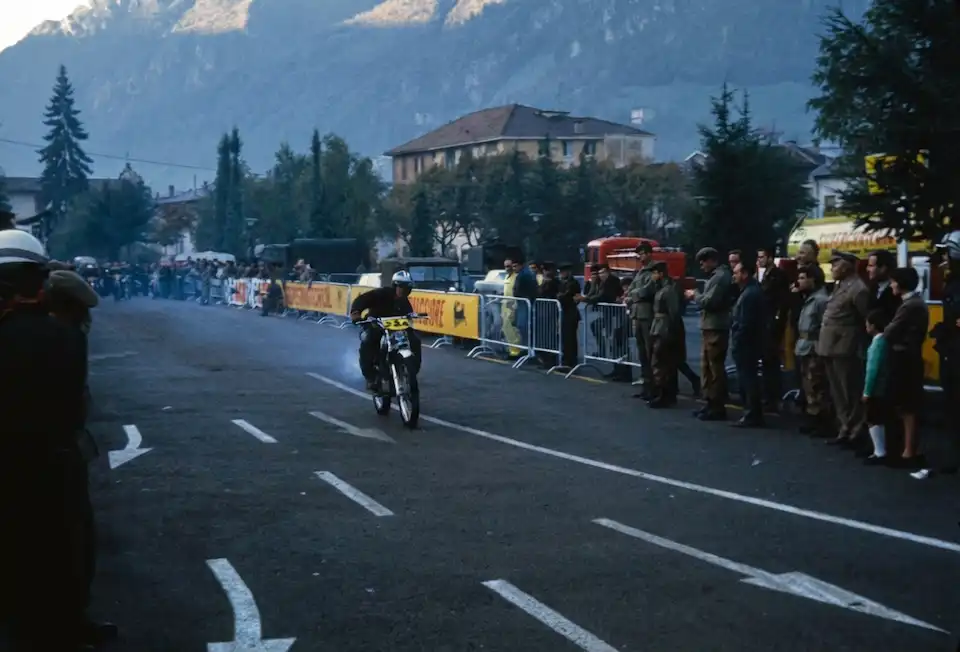
The sun had barely risen when the event began. The US riders all started and made their way onto the course proper. The first day created a few problems, bikes broke and DNFs occurred, pretty normal stuff. Bud Ekins used to say that if you made it through the third day, unless something unforeseen happened, you were going to finish, and even though San Pellegrino was a tough event, that proved to be true for the American entrants.
Each morning I got up, put on my gear, went to the Start, and when the US riders were gone, spent a few minutes getting orders and information from Ferdinand Schmalz, then got on a factory Hercules and rode off to the checkpoints. Generally I did between 150-175 miles for five days, and it was a blast. A 125 that would run with Italian traffic on the pavement was a total kick.
Ferdl passed away several years ago, but he was the funniest German rider I met. He began as a boxer who tried trials riding, then ended up competing for Victoria and working at Hercules.
In Poland in 1967, he was part of the factory support crew. One of the Victoria riders went down in a parking lot prior to the event and broke a leg. The bike was fine, and since Ferdl was the only member of the group who had a competition license, he was drafted to ride the Six Days in place of the injured rider. He had a great ride, got gold, and said it was his best ride ever. He picked out my 1967 ex-works Hercules when I went down to the factory in May of 1968, and I got to know him even better in San Pellegrino. His initial foray into English involved Dick and Jane, and he would regularly recite somewhat-modified versions of those famous books. “Hello, my name is Dick, this is my sister Jane, and here is our dog Spot. Watch out, or Spot will piss on your shoes!” Mike Rosso also has some terrific Schmalz stories.
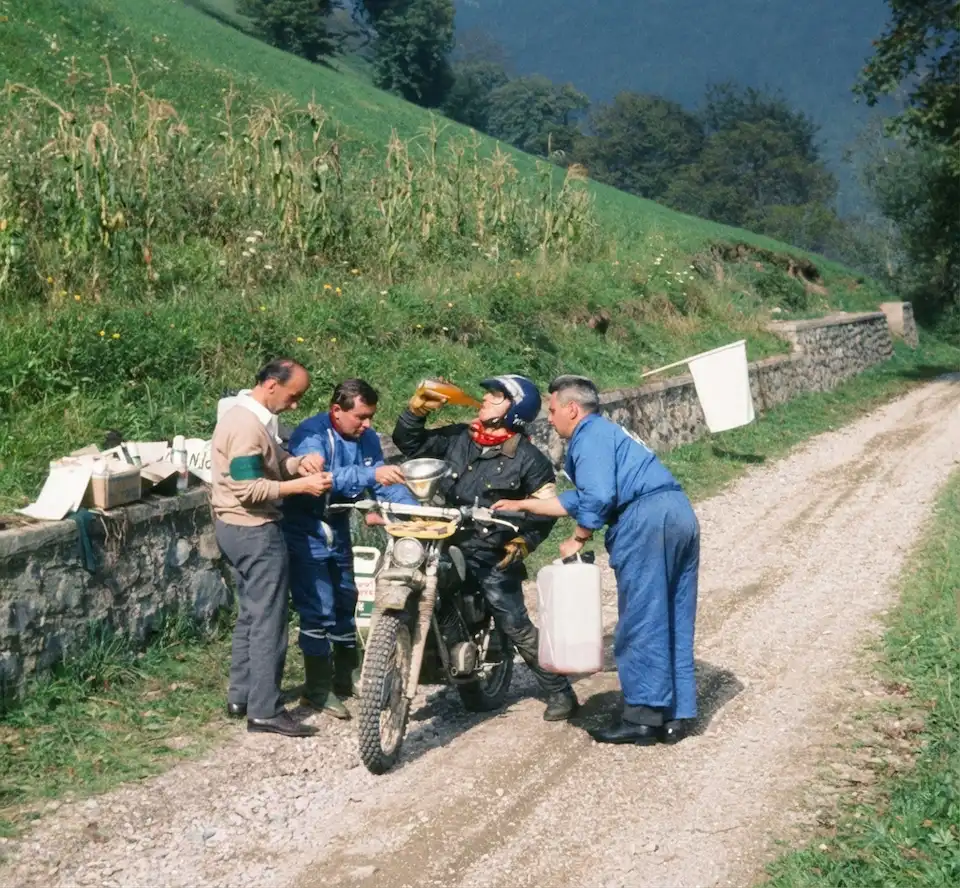
Even though I did some translating for the Penton riders, because the Americans essentially pitted together – on opposite sides of the trail, but within spitting distance – mostly the west coast riders occupied my time. Evenings were different. Everybody strolled around San Pellegrino and chatted with one another, regardless what part of the States they were from, or where else for that matter. The common lament was that American enduros were so different from the European version that they didn’t offer preparation for the ISDT. In Europe a rider had to go hard right out of the box in terrain tests, and except for the Berkshire Trial, there simply was nothing comparable in the States. Until I got back to the States and rode a few enduros, I didn’t appreciate their thoughts.
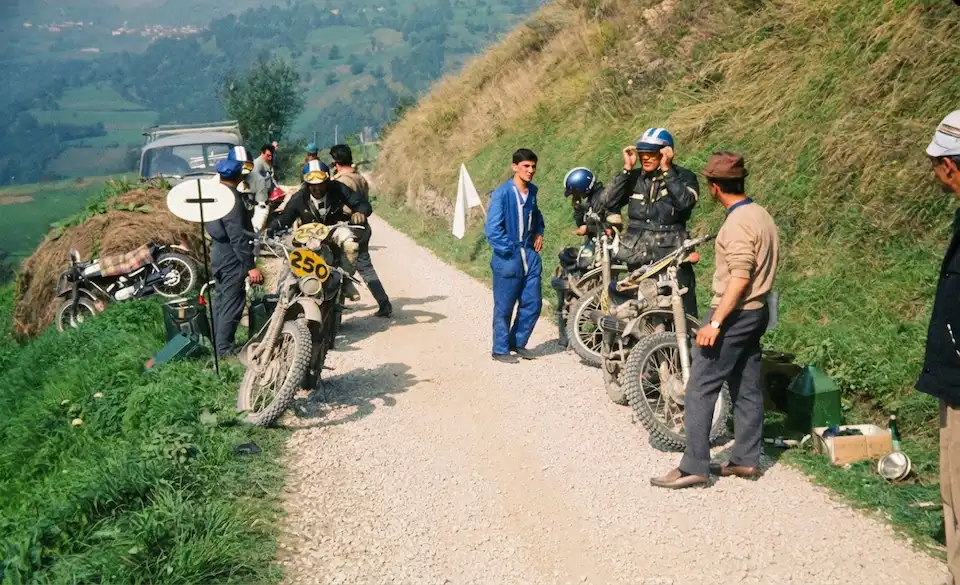
When Werner Salevsky lost his bike over a cliff mid-week, the chances of the East German Trophy team repeating were essentially gone. The competition narrowed to the West Germans, the Italians, and the Czechs. I asked Tom Penton if he worried about crashing and he shook his head. “No. It can’t occupy your mind. If it does, you will crash. Think about the ride, that’s all.” Good advice.
By the end of the third day, just as Bud Ekins said, things had pretty much shaken down for the American riders. The occasional clandestine gearbox adjustment, but not much else. Horst Fischer was working on a gearbox – out of sight of the checkpoint and any officials – when someone came up and told him what he was doing was illegal. Horst glanced up at the guy, looked over his shoulder at the drop off behind him, smiled and said, “It’s a long way down, isn’t it?” The fellow hurried away.
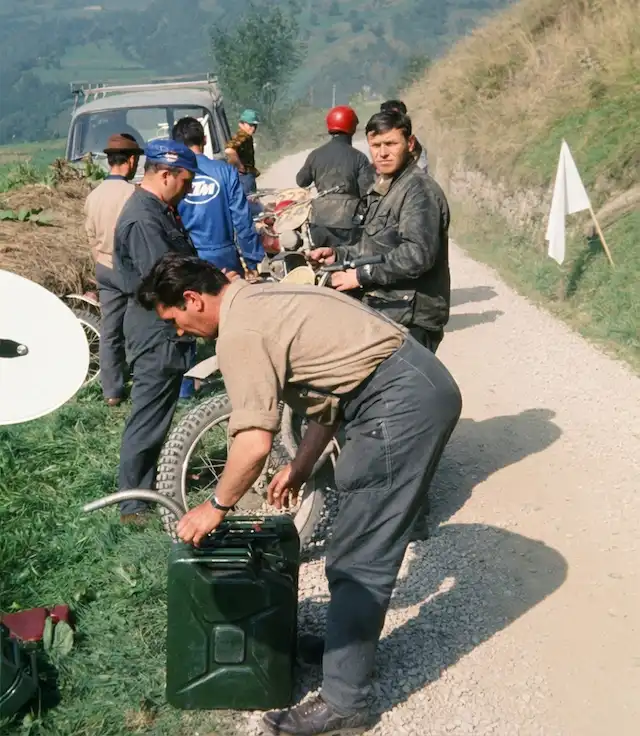
Sachs support crews mingled until the next lap. Horst Fischer in the foreground, Adolf Scheuenstuhl eying the camera.
Regardless of which little hilltop village the Checkpoint was in during the week, the local populace crowded around, cheering for the Italian riders and staring quietly at the foreigners. At some point, a priest would appear with a camera, the rows of watchers would part, pictures of the entrants would be taken, the priest would speak quietly to the people before heading back to the Rectory and the gap in the crowd would close up. The priest would be different at each village, of course, but the routine never varied.
On the fourth or fifth day, John Penton cut too close to a steel tent peg with a mushroomed top and sliced through his boot into his leg. After impounding, he went to the local hospital to get the injury seen to. Once he was sutured and bandaged up, the story continued with two different endings. Either he hobbled out of the hospital and rode the next day or he was kept overnight for observation and shinnied down a drain pipe from his hospital room and escaped to ride the next day. LeRoy Winters and David Mungenast might be responsible for the second version. John probably remembers.
For the final day, the course was shortened and the day finished at Monza and the road race test. The East Germans all put on road race leathers and looked deadly serious, even though the Zundapps were going to take the Trophy unless mechanical issues intervened.
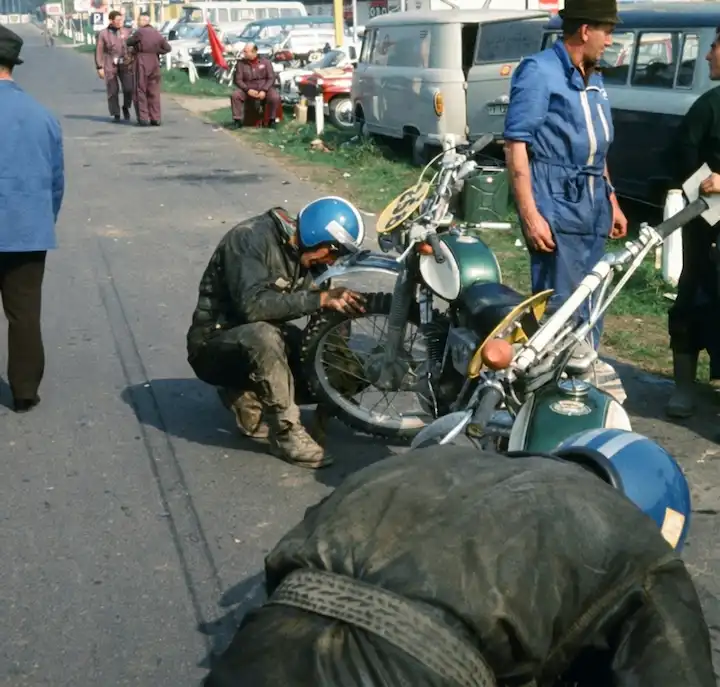
The event was over. Bikes were loaded up and everyone drove back to San Pellegrino. The West Germans had won the Trophy. Tom Penton and Al Rogers won Silver medals. John Penton, Bob Ewing, Wolfe Jackson, Jim Camaret, and Dave Mungenast got Bronze. The overall winner of the event was the same as the year before in Poland: Erwin Schmider, undeniably the most successful off-road rider in history. In 1967 he won on a 75cc. Zundapp, in 1968 on a 402cc. banana-framed Jawa sponsored by the Neckermann department store chain, the West German equivalent of Sears.
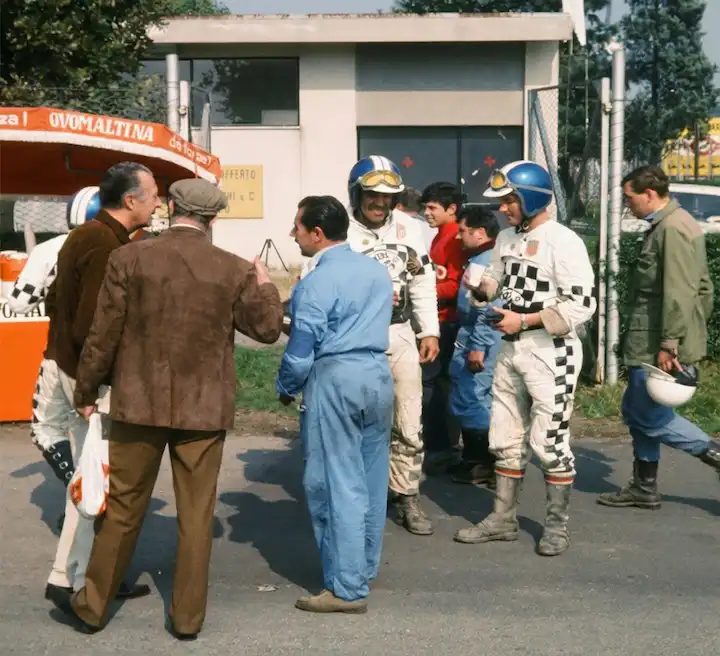
The closing ceremonies were festive, the west coast riders somewhat more so, and Al Rogers – my roommate – woke me up at two in the morning to show me some really excellent pictures an Italian photographer had taken of him.
On the morning after the event, I was up before Al – no surprise there -- and went down into the breakfast area. Dave Mungenast waved me over to where he sat with Herr Trunkenpolz and I was treated to a meal listening to two very different people discuss off-road motorcycling. Herr Trunkenpolz was reserved and thoughtful; David rather closer to the other end of human behavior. The subject of the lack of prepatory events in the States came up again, as well as the future of Penton motorcycles.
I left with the Kaisers and Horst Fischer in mid-morning, heading for the Brenner Pass and Austria. We stayed that night in a family–run hotel where Max Kaiser was well-known. Assorted younger family members were trotted out and presented to the guests, and if you wanted your shoes shined, you left them in the hall when you went to bed.
The next day we drove into Garmitsch/Partenkirchen, and Herr Kaiser cheerfully pointed out various spots where Hercules riders habitually performed unauthorized maintenance during events. The Germans were highly organized when it came to ‘catching a fiddle,’ as the Brits called it. One particularly good one was a small barn with doors on both ends. The Sachs crew had a windlass-style device which could be clamped onto a Hercules front end and straighten it. “In and out in less than a minute,” Herr Kaiser proudly told me as we sped past the barn.
A week after getting back to Schweinfurt, Chris and I and the two kids headed off to Fort Riley, Kansas for a year-and-a-half of good duty and a pair of goddawful Kansas winters. I had two Hercules – the 1966 73cc. and a 1967 ex-ISDT 125cc. – and four engines. Life was good.
I rode three enduros while I was at Riley, and quickly found out that time-keeping required considerable thinking, which really wasn’t for me. I wanted to ride to the next Checkpoint and wait for my number to come up. Thinking interfered with riding. I would never be Bill Baird.
A trip to Oregon during the Summer of 1969 convinced me that the best riding in western Oregon was in McMinnville, so in January of 1970 we loaded the Hercs on a trailer and headed west.
What became the Trask Mountain Motorcycle club in McMinnville put on several observed trials during 1970 and we got acquainted with the very supportive Hodaka people through those events. At the District 28 Sanction meeting in November the club put in for a one-day Reliability Trial in May of 1971. In the meantime, the AMA became the FIM affiliate for the United States, and in January 1971, Mike Vancil called and asked if we could put on a two-day event. Fools that we were, we said ‘yes.’ The Trask Mountain Two Days Trial was born, and for the next twenty-five years it dominated our lives. Okay, most of this was serendipity, the right people in the right places at the right times, but the influence – on me, at least – in Italy in 1968 was the deciding factor. The US riders, particularly John Penton and David Mungenast, showed what needed to be done in the States and a bunch of hard-working club members in a small town in Oregon made it happen, at least in that small town.
And it was fun. Most of the time.