Bob Rush (Radar)
Member Profile
story and photos by Bob Rush
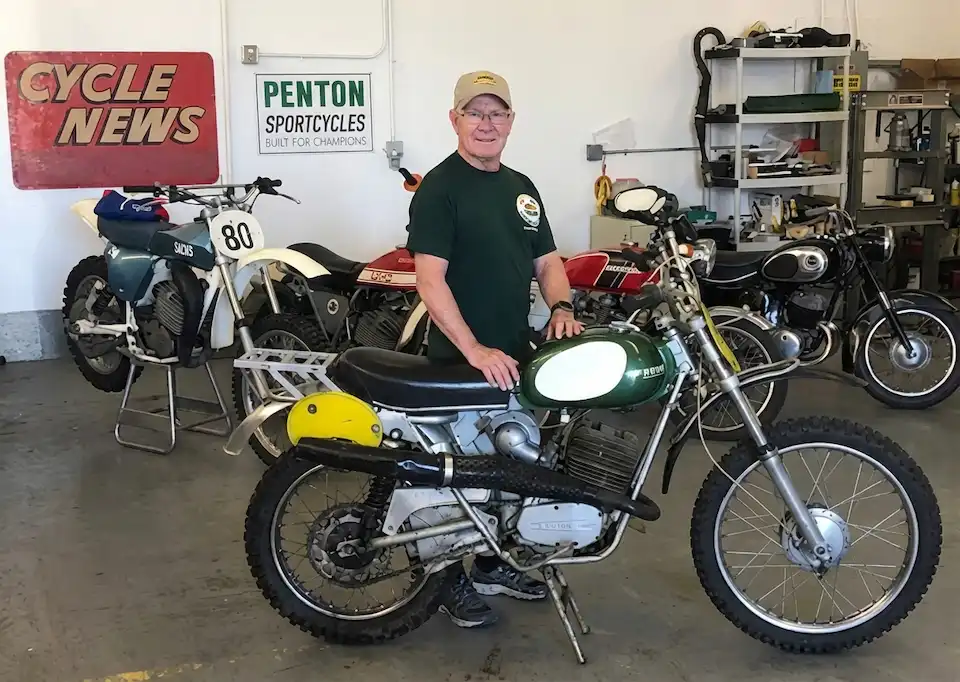
I was born in Lorain, Ohio, and thanks to John Penton, it became the epicenter for dirt bikes east of the Mississippi.
Growing up, I learned a lot about tractors, cars, go carts, minibikes and motorcycles because my family was always working on them.
I can’t say that I loved riding on motorcycles at first. My dad had a 1952 Harley side shift and it made me nervous when he took his hands off the handlebars to shift. But, that all changed when my uncle visited when I was 12 years old. He had his 175 Allstate (built by Puch) and he removed the seat for me so I could touch the ground and I took it for my first ride. Shifting gears and increasing speed was a true pleasure.
I had just started riding when our family moved to Amherst in 1966. It was a fortunate move for me because I got to go to school with Jack and Jeff Penton and our neighborhood was quickly converted to a 2 wheel neighborhood. We all went riding in the evenings.
My first motorized 2 wheeler was a 3 ½ HP Rupp mini bike. I rode the wheels off of it. Then, I wanted a true dirt bike and I bought a well-used Suzuki 120 Bearcat. This bike really introduced me to trail riding. We had a lot of wooded area to use and I would go riding almost every day after school.
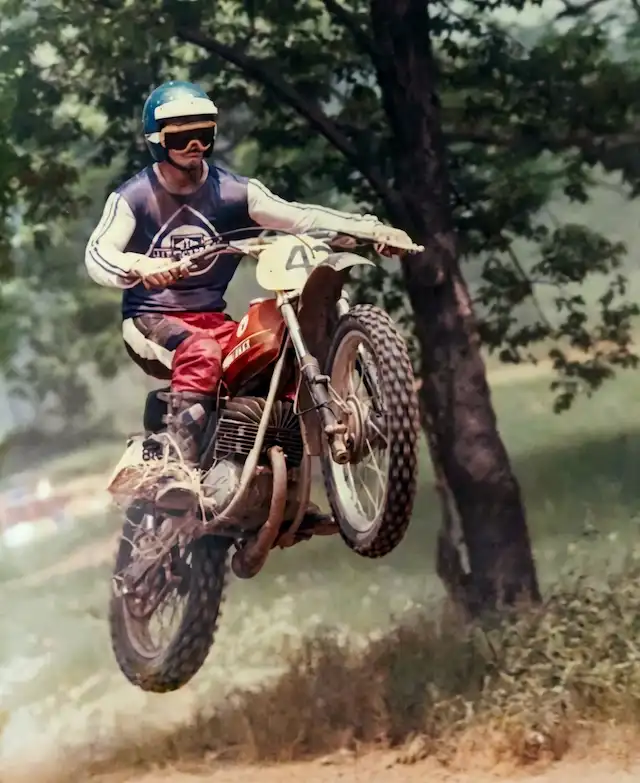
I soon grew tired of the Bearcat and wanted a Penton. I worked at restaurants as a bus boy, dishwasher, waiter or any position to make money. I saved enough money to buy a used 100cc Berkshire Penton Steel Tanker from our local Yamaha dealer who took it on trade for $450.00. It was a 1969 and I rode that bike until The CMF’s came out. That Steel tanker really educated about what a true dirt bike is. It taught me about preparation, confidence and being humble and it helped me to become a Penton/Sachs mechanic.
After Jack returned from the 6 Days in 1972, I decided I had to have a CMF series. He had been riding one at our local track and it was lower and longer than the steel tankers. I had to have one.
So, I went to the Penton Honda shop and gave Ralph a down payment for the next 100cc CMF. One came in and he sold it to a classmate and friend, Jeff Gerber. I have to say I was pissed!! But, it worked out for me because the next bike that came in was a Sachs B series engine and it was a bit faster than the A series that was almost mine. This was a much different handling motorcycle than the steel tanker. The steel tanker felt like you were riding on top of the bike and the CMF felt like you were more into the bike. This motorcycle was a great motorcycle and I won or placed in many races in Ohio, Indiana, Pennsylvania and West Virginia.
I’ll never forget the day at Meadowlarks (our local track) when Jack Penton came up to me carrying a pair of leathers and said to me, “Do you want my old leathers? I think you’re going fast enough to get hurt now.” I was very proud to receive them although the lining was gone. I wore those black leathers with a yellow stripe running down each side for a long time. Somehow along the way I earned the nickname Radar. I thinks it was because I resembled Radar from the TV show MASH, but I would like to think it was because I was intuitive. A lot of my old motorcycle friends to this day still call me Radar. I decided to buy a second generation Jackpiner with the KTM engine and Bing carburetor. It was a bit heavier than the Berkshire but I loved the power.
In 1972 I picked up an after school job at Penton Imports replacing the cast iron cylinder engines in the Mudlarks with Sunburst cylinder engines. We also had to air chisel the name Sachs from the engine side covers and install the Penton plaque in its place. After we converted two or three units, we had to test ride them. This was the reward for our work. Penton imports was an old skating rink which made a great oval track. (Maybe I should not have stated this).
The Service manager for Penton, John Cobb, decided to leave Penton and to start his own business. On the weekends, I would ride his highly modified 175 Penton in local races to promote Penton and his business. His business was located in the lower level of a building and Toppers motorcycle accessories was located on the upper level. I also promoted Toppers as well.
John Cobb’s 175 Penton had a Husqvarna rear wheel with a full floating rear brake that really improved the braking and reduced wheel chatter during hard braking. It was equipped with Marrizzoci forks, a Husqvarna seat and a Husqvarna stainless steel rear fender. It had a louvered air cleaner cover and the engine was bead blasted to a reveal the natural aluminum color.
I think the reason for the key Husqvarna parts was that Husqvarna imports were about a city block away from Penton R&D. This bike was fast. I cannot ever remember losing a start on this ride and finished in the top 2 positions every time out. I guess John needed some money and one day John sold my ride to Jeff Gerber and he rode it proudly.
I started working for Penton R&D shortly after that rebuilding Sachs and KTM engines. KTM’s were my specialty. This was the time when we could not get enough 175 cylinders from the factory to repair the engines. The cast in cylinder skirts would break off during engine failure and the fix that came from Ted Penton and Dane Liembach was to weld the skirt back on and then hone it to fit a new piston. This worked and I honed a lot of cylinders. Rebuilding engines came easy to me but Dane taught me how to use the Sunnen honing machining.
Around 1974, as I was mastering my craft, I was approached by Doug Wilford and he asked if I would be interested in working for Puch on west 28th street Cleveland, Ohio. I asked if I was going to be paid more than Ted was paying me, he said yes and I said OK let’s go. I am doing a little speculating here but I feel it is very close to the facts. Puch was Imported to Downingtown, PA at the time and Bob Hoffer was the GM. Fritz Dengel was the owner of record and I think, John Penton was involved to some degree (for all you Penton guys this name should ring a bell). Bob died from cancer and Fritz moved the operation to Cleveland Ohio.
Doug Wilford and I joined Fritz to support the Puch motorcycles. We had just unloaded a container of Puch new style MX and enduro models with the down pipes and they shipped out fast. I rode a 125 Puch and it really handled well but it didn’t have the HP of the Japanese or the Pentons, but I won a lot of hare scrambles on it. Then, Puch pulled the plug on the US just as the mopeds were taking off. They stopped importing to the US. I personally inventoried the parts, packed them up and along with the bikes that were left, shipped everything to Bombardier.
I never will forget the signed agreement from Mr. Trunkenpolz that hung on the wall behind Fritz’s desk. It stated Fritz will receive 5% on everything shipped to the US for KTM. Something went awry because KTM never paid Fritz and only 2 people know why, but I think John Penton could help clear this up. I recently contacted Hanelore, Fritz’s wife to see if she had I retained that document between Fritz and KTM, but she said she did not think so.
There were a few crates of parts sitting in the back that came from the 1973 ISDT. I just had to save a few parts from the scrap and I asked Fritz for them. He told me to take what I wanted and I saved an exhaust pipe from a 125CC six day bike. It was custom made for those motorcycles. I hung it in my father’s garage and it hung there for at least 25 years still wrapped in the crate paper to protect it. One day, I ran into Mike Rosso and he told me that Fritz gave him a six day 125cc Puch. Mike said the only thing missing was the exhaust pipe. I felt good when I told him that I had one and I gave it him.
At this time Fritz, received a telex from Puch asking to help facilitate a transportation and any support needed for one rider and a mechanic to campaign the 1974 Trans am on a 380cc Puch prototype. They shipped 2 bikes, a bunch of spare parts and about 10 tires by air and I picked them up at the Cleveland airport.
A few days later, I picked up Harry Everts (the rider) and his family and the mechanic. Harry’s son, Stephan, had to be about two at the time. Harry’s wife and son returned to Europe after the first 2 races, but he continued on and finished 5th in the series. I flew for the first time to LA and Harry picked me up at the airport. I was there to go to the final race then drive the van back to Cleveland with 2 priceless motorcycles in the back.
Harry was a lot of fun. I was so intrigued about the Marzocchi front forks on his motorcycle that he gave me a set of prototype forks and front wheel but not the triple clamps.
In 1974 Fritz felt he needed to stay in the motorcycle business. As Puch moved out the back door, Fritz made a deal with Hercules/Sachs and they moved in right away. This worked out for Doug and me.
Hercules sent a Wankel-powered dirt bike for Doug to ride the qualifiers. I felt it was bulky but it seemed to have good power. Jack Penton rode it in the Corduroy enduro but DNFed due to engine seizing. In 1975 Doug Wilford rode a Wankel in the Isle of Man ISDT. He DNFed due to a broken rib. I think that was Doug’s last ISDT
During the Puch and Hercules time, John Penton would visit Fritz. They were good friends. I told Fritz that I was tired of driving from Amherst to Cleveland every day so I told Fritz about a piece of property I saw for sale in Westlake. Fritz bought it and built a 30,000 sq. ft. warehouse with 10,000 sq.ft. of first class offices. Where we stocked MX and endure motorcycles as Wankel street bikes , but the largest volume of the warehouse was taken up my mopeds. Fritz had a vision for mopeds that started with the Puch Mopeds. Fritz’s famous tag line was “I want to sell 10,000 Maxies( referring to the Puch maxie). During the moped frenzy there were many different state requirements. There were 20, 25, 30 mph mopeds as well as colors, green, blue, red and 2 different models the 504 series and the 505 series. This took a lot of the warehouse space. Fritz and I had a very good friendship that lasted until his death.
Fritz used to tell me stories about his life. But one story that may interest our members, Fritz told me that he loaned a large suitcase to John so he could carry parts to KTM. One day while standing in the drive of Sachs in Westlake Ohio. John came walking up the drive with the large suitcase and returned it to Fritz. Fritz looked over at and said” that’s the suitcase I lent to John long ago”. The two met and laughed a bit. I was handed the suitcase and I placed in the warehouse above the restrooms. I sure wish I had it today.
In late 75/ early 76, Fritz contracted a guy , Jim Paledgy from Texas to build a MX250 using a 250cc Seven speed engine. Fritz brought him up from Texas and he worked out of Hoss industries shop and rotational molding factory. We rode the bike and then sent it to Germany. This is what pushed Hercules to build the MX 250 and 200 cc motorcycles. Sounds like John Penton move to me??
In 1976 we campaigned the ISDT qualifiers with some great riders. Mike Rosso, Drew Smith and Billy Uhl. I would support the campaign where needed, whether it was team manager or gofer. Whatever it takes is what I always said.
While all were at the 1976 Six Days in Austria, I was at the IFMA show in Koln, Germany. I traveled to the Hercules factory to test ride the new 250 MX. Some changes were requested. Later, the 250 MX showed up in Cleveland with the changes. We rode the bike it was better, but needed more. I think that bike or its twin showed up in Mike Mcgown’s collection.
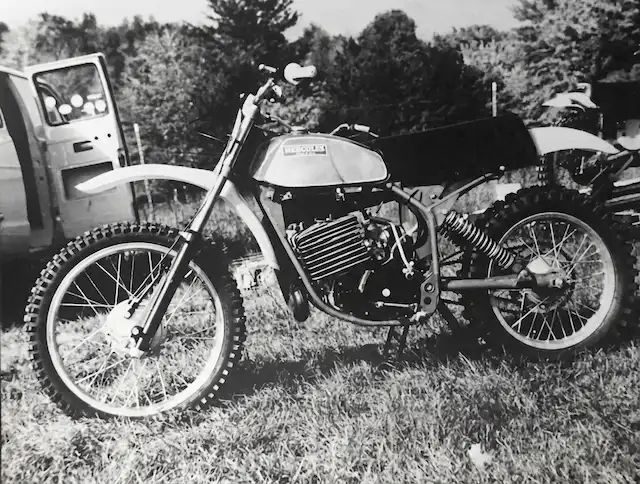
Later that year, the factory sent 3 early production/ prototypes to the US and I picked them up from the airport. We contacted a few magazines to do articles on the new Sachs MX 250 and 200 cc. I was lucky enough to accompany the bikes for the testing and I was allowed to take part in the testing. There was one 250cc and two 200CC units. Fritz contracted Frank Stacy to campaign the Trans Am support class in 1977. They were basically pilot production/prototypes that were modified to Franks liking.
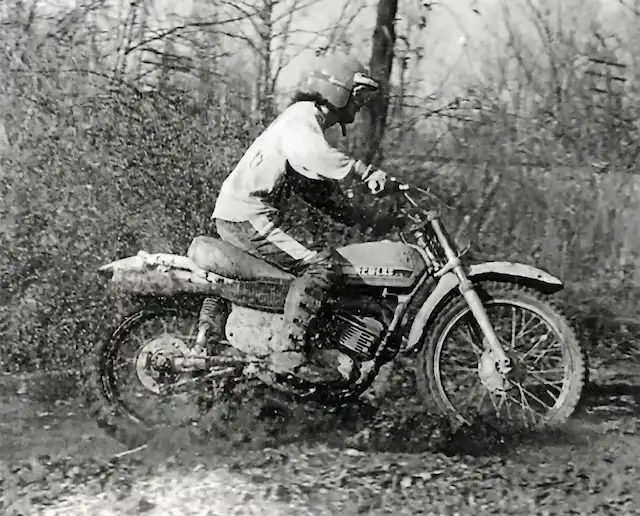
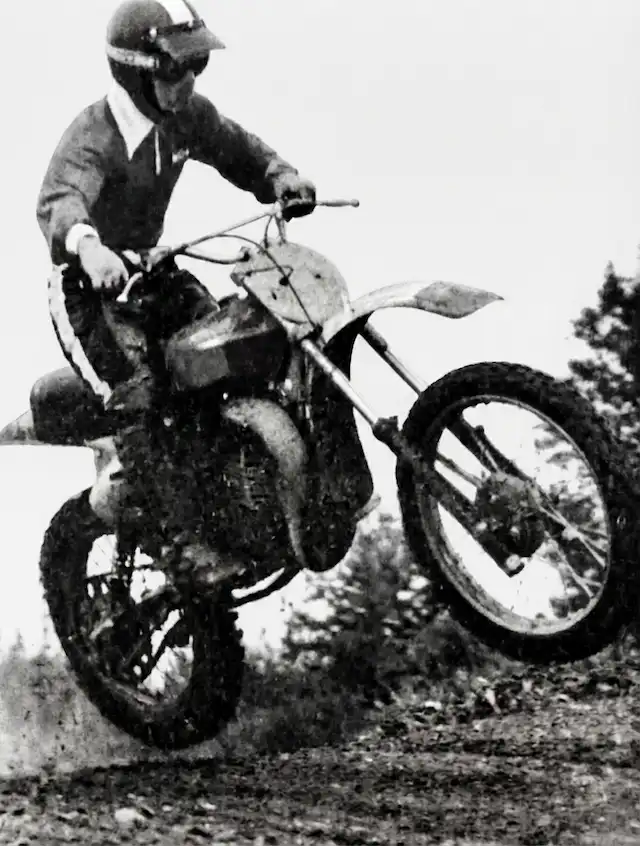
The rear wheel was a KTM rear wheel assembly, the swing arm was reinforced along the bottom. Fox air shocks and Preston Petty fenders were used. A mount was welded to the frame that was used to mount a skate board wheel. This was needed to guide the chain correctly through the KTM chain guide block. The steering was modified to turn sharper and that meant that the handmade aluminum coffin style gas tank need to be modified to allow clearance for the fork tubes. A little heat, a piece of pipe and a hammer did the trick. Frank and his personal mechanic, Pete, took the cylinder to Ivan Boyesen to improve the engine performance, and it did. Frank ended up in 9th overall for the series. Not too bad for a prototype and a great rider.
In January 1978, I left Sachs because I was getting married and needed a job that was more mainstream. Motorcycles are great but it did not bode well for an aging rider and I did not know how long Sachs was going to be around. My coworker, Buzz Kirchner, said he could get me an interview with his family friend at MTD Products (Modern Tool and Die, the largest lawn and garden manufacture in the world located just 20 minutes away) . I interviewed on a Saturday and started 2 weeks later and remained there for 25 Years. I was project manager for the Columbia bike/ moped division located in Westfield, Mass. I evolved to the lawn and garden and took the position of Chief Engineer for the Cub Cadet group after MTD bought the Cub Cadet line from International Harvester back in 1984. I resigned from MTD two years after being put in charge of the Advanced Concept Group. It was a great job.
I bought a Bed and Breakfast on an island in Lake Erie called Put in Bay. I ran the B&B for 13 years. I now own a small business where we design, develop, source and supply parts for the appliance, caster and Auto aftermarket industries.
We also supply bearings and seals to OEM’s.
Late in 1976 Fritz was feeling big financial pressure due to the fact that the Japanese were hurting the European motorcycle business. Fritz and I planned a lot together. He taught me a lot about business strategy. He said to me I think I will import to my credit limit, then I will tell the factory that the business was failing and they should take the motorcycles back. He knew this news would not be received well by the Hercules factory. As he predicted, he made a proposal to the factory which they jumped on. The proposal was to buy him out. I will lease you my building for 10 years at $8,000.00 per month and you can run the business. Hercules sent 2 great guys over and they ran the business, Fritz was kept on as Director Emeritus. Fritz paid about $350,000 for the land and building. Good return on investment. After 10 years Sachs bought the building for more than 1.5 million. Good move Fritz.
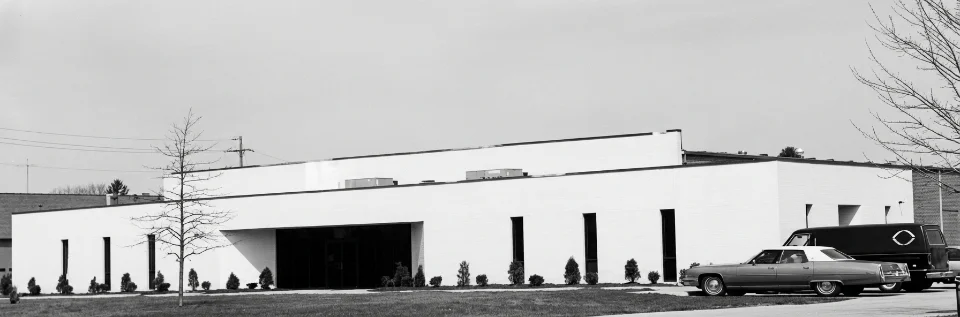
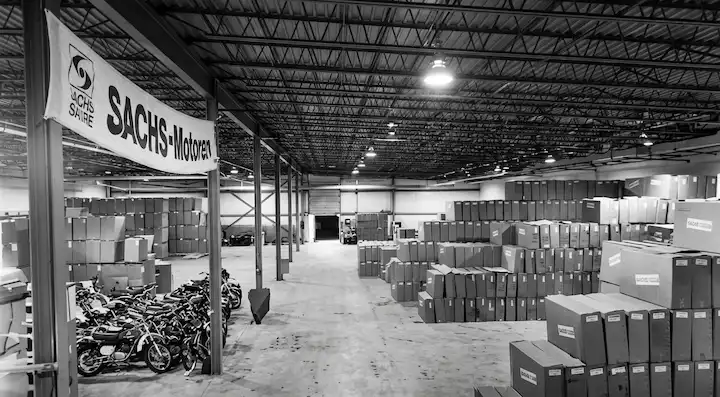
Sachs bought out Fritz and continued selling motorcycles until 1979 then converted the building into their core business of importing auto clutches and shocks. Sachs was purchases by ZF and they are still in operation today but I do not know what is going on inside the walls of that building.
I still love motorcycles today and I have a small collection of the motorcycles that are dear to me.
I have a 1969 and a 1970 Steel tanker six days, 1974 Puch, 1974 Hercules Wankel, 1977 Sachs 250 MX serial number 1. This is the bike that was modified for Frank Stacy and a 1965 Allstate (Puch) each one of these motorcycles have played a part in my motorcycle life.
In conclusion, you could say I Forest Gumped my way through motorcycle industry. I grew up in an area that was the hub of the dirt bike world east of the Mississippi and I happened to be there and experienced many developments. I had the opportunity to meet and ride with some of the great riders that some only read about in magazines names like Bengt Alhberg, Torleif Hansen, Heike Mikola, Torsten Hallman, Dick Burleson, Malcom Smith, Harry Everts and a young Steffan, Jack, Jeff, Tom Penton, Dane Leimbach, Doug Wilford, Mike Rosso, Paul Danik, Billy Uhl, Carl Cranke and of course John Penton. That Penton motorcycle gave me a direction early on in life and what it taught me was invaluable and it helped me greatly during my professional career.
Who was Fritz Dengel?
Back in the Fall 2012 issue #56 of the Still Keeping Track newsletter, a Tanker Talk article was published titled “The Fritz Dengel Connection”. In the article Fritz had a retail import business called Hanza Import Haus on Lorain Ave at West 28th Street in Cleveland and that business is still in operation today under new ownership.
In 1966 KTM was looking to expand their business to the USA. Kalman Cseh who was an employee of Mr. Trunkenpolz contacted his cousin Fritz Dengel in the USA and a deal was made to build and ship Sachs powered Hanza street motorcycles.
Fritz contacted John Penton in 1967 in hopes of having John purchase and sell his Hanza motorcycles. John accepted two of those bikes, reluctantly to try out. Jack Penton was a test rider for one of those bikes and wound up breaking the bike in half at a motorcycle race, thus killing any deal. The broken bike however, eventually led John Penton to KTM and their agreement to build the Penton brand of motorcycles. This was reported in the John Penton movie.